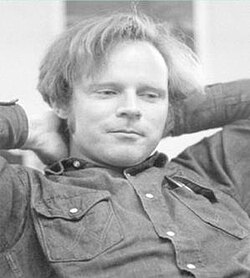
Biography
Robert W. Floyd [ 1 ] (born Robert Willoughby Floyd ; June 8, 1936 – September 25, 2001) was an American computer scientist . His contributions include the design of the Floyd–Warshall algorithm (independently of Stephen Warshall ), which efficiently finds all shortest paths in a graph and his work on parsing ; Floyd's cycle-finding algorithm for detecting cycles in a sequence was attributed to him as well. In one isolated paper he introduced the important concept of error diffusion for rendering images, also called Floyd–Steinberg dithering (though he distinguished dithering from diffusion). He pioneered in the field of program verification using logical assertions with the 1967 paper Assigning Meanings to Programs . This was a contribution to what later became Hoare logic . Floyd received the Turing Award in 1978. Born in New York City , Floyd finished high school at age 14. At the University of Chicago , he received a Bachelor of Arts (B.A.) in liberal arts in 1953 (when still only 17) and a second bachelor's degree in physics in 1958. Floyd was a college roommate of Carl Sagan . [ 2 ] Floyd became a staff member of the Armour Research Foundation (now IIT Research Institute ) at Illinois Institute of Technology in the 1950s. Becoming a computer operator in the early 1960s, he began publishing many papers, including on compilers (particularly parsing ). He was a pioneer of operator-precedence grammars , and is credited with initiating the field of programming language semantics in Floyd (1967) . He was appointed an associate professor at Carnegie Mellon University by the time he was 27 and became a full professor at Stanford University six years later. He obtained this position without a Doctor of Philosophy (Ph.D.) degree. Fields: Computer science Education: University of Chicago BA BS Award Citation: Turing Award (1978) Computer Pioneer Award (1991)
About the Turing Award
The ACM A.M. Turing Award is an annual prize given by the Association for Computing Machinery (ACM) for contributions of lasting and major technical importance to computer science. It is generally recognized as the highest distinction in computer science and is colloquially known as the "Nobel Prize of Computing."
Quick Facts
- Award: ACM A.M. Turing Award
- Added: 2026-02-07
- Source: Wikipedia
- Prize: $1,000,000 (USD)
- Presented by: ACM
Browse More
Notable Winners
- Donald Knuth (1974)
- Tim Berners-Lee (2016)
- Geoffrey Hinton (2018)
- Yoshua Bengio (2018)
- Yann LeCun (2018)