Biography
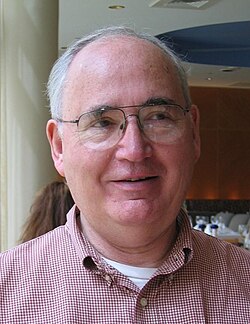
Dana Stewart Scott (born October 11, 1932) is an American logician who is the Hillman University Professor emeritus of Computer Science , Philosophy , and Mathematical Logic at Carnegie Mellon University . [ 1 ] He is now retired and lives in Berkeley, California . He and Michael O. Rabin won the 1976 ACM Turing Award for their work on automata theory , while his collaborative work with Christopher Strachey in the 1970s laid the foundations of modern approaches to the semantics of programming languages . He has also worked on modal logic , topology , and category theory . He received his B.A. in Mathematics from the University of California, Berkeley , in 1954. He wrote his Ph.D. thesis on Convergent Sequences of Complete Theories under the supervision of Alonzo Church while at Princeton , and defended his thesis in 1958. Solomon Feferman (2005) writes of this period: Scott began his studies in logic at Berkeley in the early 50s while still an undergraduate. His unusual abilities were soon recognized and he quickly moved on to graduate classes and seminars with Tarski and became part of the group that surrounded him, including me and Richard Montague ; so it was at that time that we became friends. Scott was clearly in line to do a Ph. D. with Tarski, but they had a falling out for reasons explained in our biography. [ 2 ] Upset by that, Scott left for Princeton where he finished with a Ph. D. under Alonzo Church. But it was not long before the relationship between them was mended to the point that Tarski could say to him, "I hope I can call you my student." Fields: Computer science, Mathematics, Philosophy Education: University of California, Berkeley BA Princeton University MA PhD Award Citation: Leroy P. Steele Prize (1972) Turing Award (1976) Tarski Lectures (1989) Harold Pender Award (1990) Gödel Lecture (1991) Rolf Schock Prize (Logic and Philosophy) (1997)
About the Turing Award
The ACM A.M. Turing Award is an annual prize given by the Association for Computing Machinery (ACM) for contributions of lasting and major technical importance to computer science. It is generally recognized as the highest distinction in computer science and is colloquially known as the "Nobel Prize of Computing."
Quick Facts
- Award: ACM A.M. Turing Award
- Added: 2026-02-07
- Source: Wikipedia
- Prize: $1,000,000 (USD)
- Presented by: ACM
Browse More
Notable Winners
- Donald Knuth (1974)
- Tim Berners-Lee (2016)
- Geoffrey Hinton (2018)
- Yoshua Bengio (2018)
- Yann LeCun (2018)