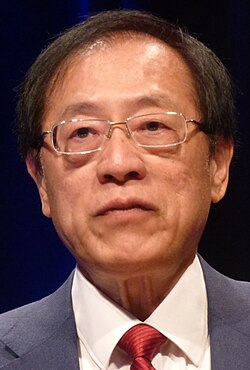
Biography
Andrew Chi-Chih Yao ( Chinese : 姚期智 ; pinyin : Yáo Qīzhì ; born December 24, 1946) is a Chinese computer scientist , theoretical physicist , and computational theorist . He is currently a professor and the dean of Institute for Interdisciplinary Information Sciences (IIIS) at Tsinghua University . Yao used the minimax theorem to prove what is now known as Yao's principle . After graduating from National Taiwan University , Yao earned a doctorate in physics from Harvard University in 1972 and a second doctorate in computer science from the University of Illinois in 1975 before teaching mathematics and computer science as a professor at the Massachusetts Institute of Technology , Stanford University , and the University of California, Berkeley . In 1986, he became the William and Edna Macaleer Professor of Engineering and Applied Science at Princeton University . He won the 2000 ACM Turing Award . Yao was a naturalized U.S. citizen, and worked for many years in the U.S. In 2015, together with Yang Chen-Ning , he renounced his U.S. citizenship and became an academician of the Chinese Academy of Sciences . [ 1 ] [ 2 ] [ 3 ] [ 4 ] Fields: Computer science, Theoretical physics Education: National Taiwan University BS Harvard University MA PhD University of Illinois, Urbana-Champaign PhD Award Citation: George Pólya Prize (1987) Knuth Prize (1996) Turing Award (2000) Kyoto Prize (2021)
About the Turing Award
The ACM A.M. Turing Award is an annual prize given by the Association for Computing Machinery (ACM) for contributions of lasting and major technical importance to computer science. It is generally recognized as the highest distinction in computer science and is colloquially known as the "Nobel Prize of Computing."
Quick Facts
- Award: ACM A.M. Turing Award
- Added: 2026-02-07
- Source: Wikipedia
- Prize: $1,000,000 (USD)
- Presented by: ACM
Browse More
Notable Winners
- Donald Knuth (1974)
- Tim Berners-Lee (2016)
- Geoffrey Hinton (2018)
- Yoshua Bengio (2018)
- Yann LeCun (2018)