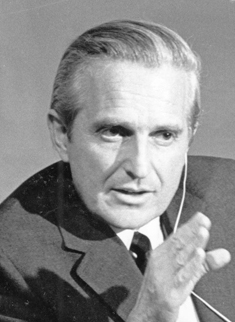
Biography
Douglas Carl Engelbart (January 30, 1925 – July 2, 2013) was an American engineer, inventor, and a pioneer in many aspects of computer science . He is best known for his work on founding the field of human–computer interaction , particularly while at his Augmentation Research Center Lab in SRI International , which resulted in creation of the computer mouse , [ a ] and the development of hypertext , networked computers , and precursors to graphical user interfaces . These were demonstrated at The Mother of All Demos in 1968. Engelbart's law , the observation that the intrinsic rate of human performance is exponential, is named after him. The "oN-Line System" ( NLS ) developed by the Augmentation Research Center under Engelbart's guidance with funding mostly from the Advanced Research Projects Agency (ARPA), later renamed Defense Advanced Research Projects Agency ( DARPA ), demonstrated many technologies, most of which are now in widespread use; it included the computer mouse, bitmapped screens, word processing, and hypertext; all of which were displayed at "The Mother of All Demos" in 1968. The lab was transferred from SRI to Tymshare in the late 1970s, which was acquired by McDonnell Douglas in 1984, and NLS was renamed Augment (now the Doug Engelbart Institute). [ 6 ] At both Tymshare and McDonnell Douglas, Engelbart was limited by a lack of interest in his ideas and funding to pursue them and retired in 1986. In 1988, Engelbart and his daughter Christina launched the Bootstrap Institute – later known as The Doug Engelbart Institute – to promote his vision, especially at Stanford University; this effort did result in some DARPA funding to modernize the user interface of Augment. Fields: Human–computer interaction, [ Education: Oregon State University BS University of California, Berkeley MS PhD Award Citation: National Medal of Technology (2000) Lemelson–MIT Prize ACM Turing Award (1997) [ 1 ] BCS Lovelace Medal (2001) Norbert Wiener Award for Social and Professional Responsibility Computer History Museum Fellow Award (2005) [ 2 ] NAE Member (1996)
About the Turing Award
The ACM A.M. Turing Award is an annual prize given by the Association for Computing Machinery (ACM) for contributions of lasting and major technical importance to computer science. It is generally recognized as the highest distinction in computer science and is colloquially known as the "Nobel Prize of Computing."
Quick Facts
- Award: ACM A.M. Turing Award
- Added: 2026-02-07
- Source: Wikipedia
- Prize: $1,000,000 (USD)
- Presented by: ACM
Browse More
Notable Winners
- Donald Knuth (1974)
- Tim Berners-Lee (2016)
- Geoffrey Hinton (2018)
- Yoshua Bengio (2018)
- Yann LeCun (2018)