Biography
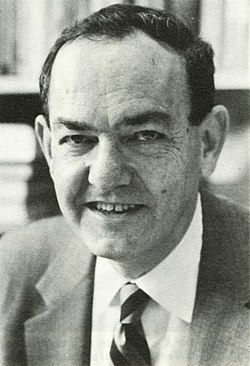
Herbert Alexander Simon (June 15, 1916 – February 9, 2001) was an American scholar whose work influenced the fields of computer science , economics , and cognitive psychology . His primary research interest was decision-making within organizations and he is best known for the theories of " bounded rationality " and " satisficing ". [ 5 ] [ 6 ] He and Allen Newell received the ACM Turing Award in 1975, and he received the Nobel Memorial Prize in Economic Sciences in 1978. [ 7 ] [ 8 ] His research was noted for its interdisciplinary nature, spanning the fields of cognitive science , computer science , public administration , management , and political science . [ 9 ] He was at Carnegie Mellon University for most of his career, from 1949 to 2001, [ 10 ] where he helped found the Carnegie Mellon School of Computer Science , one of the first such departments in the world. Notably, Simon was among the pioneers of several modern-day scientific domains such as artificial intelligence , information processing , decision-making , problem-solving , organization theory , and complex systems . He was among the earliest to analyze the architecture of complexity and to propose a preferential attachment mechanism to explain power law distributions. [ 11 ] [ 12 ] Herbert Alexander Simon was born in Milwaukee , Wisconsin on June 15, 1916. Simon's father, Arthur Simon (1881–1948), was a Jewish [ 13 ] electrical engineer who came to the United States from Germany in 1903 after earning his engineering degree at Technische Hochschule Darmstadt . [ 14 ] An inventor, Arthur also was an independent patent attorney. [ 15 ] Simon's mother, Edna Marguerite Merkel (1888–1969), was an accomplished pianist whose Jewish, Lutheran, and Catholic ancestors came from Braunschweig , Prague and Cologne . [ 16 ] Simon's European ancestors were piano makers, goldsmiths , and vintners . Fields: Economics, Artificial intelligence, Computer science, Political science Education: University of Chicago BA MA PhD Award Citation: .mw-parser-output .plainlist ol,.mw-parser-output .plainlist ul{line-height:inherit;list-style:none;margin:0;padding:0}.mw-parser-output .plainlist ol li,.mw-parser-output .plainlist ul li{margin-bottom:0} Member of the National Academy of Sciences (1967) APA Award for Distinguished Scientific Contributions to Psychology (1969) Turing Award (1975) Nobel Prize in Economics (1978) National Medal of Science (1986) Harold Pender Award (1987) von Neumann Theory Prize (1988) APA Award for Lifetime Contributions to Psychology (1993) ACM Fellow (1994) IJCAI Award for Research Excellence (1995)
About the Turing Award
The ACM A.M. Turing Award is an annual prize given by the Association for Computing Machinery (ACM) for contributions of lasting and major technical importance to computer science. It is generally recognized as the highest distinction in computer science and is colloquially known as the "Nobel Prize of Computing."
Quick Facts
- Award: ACM A.M. Turing Award
- Added: 2026-02-07
- Source: Wikipedia
- Prize: $1,000,000 (USD)
- Presented by: ACM
Browse More
Notable Winners
- Donald Knuth (1974)
- Tim Berners-Lee (2016)
- Geoffrey Hinton (2018)
- Yoshua Bengio (2018)
- Yann LeCun (2018)