Biography
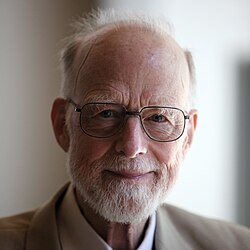
Sir Charles Antony Richard Hoare ( / h ɔːr / HOR ; born 11 January 1934), also known as C. A. R. Hoare , is a British computer scientist who has made foundational contributions to programming languages , algorithms , operating systems , formal verification , and concurrent computing . [ 3 ] His work earned him the 1980 ACM Turing Award , usually regarded as the highest distinction in computer science. Hoare developed the sorting algorithm quicksort in 1959–1960. [ 4 ] He developed Hoare logic , an axiomatic basis for verifying program correctness . [ 5 ] In the semantics of concurrency , he introduced the formal language communicating sequential processes (CSP) to specify the interactions of concurrent processes, and along with Edsger Dijkstra , formulated the dining philosophers problem . [ 6 ] [ 7 ] [ 8 ] [ 9 ] [ 10 ] [ 11 ] Since 1977, he has held positions at the University of Oxford and Microsoft Research in Cambridge . Tony Hoare was born in Colombo , Ceylon (now Sri Lanka ) to British parents; his father was a colonial civil servant and his mother was the daughter of a tea planter. Hoare was educated in England at the Dragon School in Oxford and the King's School in Canterbury . [ 12 ] He then studied Classics and Philosophy ("Greats") at Merton College, Oxford . [ 13 ] On graduating in 1956 he did 18 months National Service in the Royal Navy , [ 13 ] where he learned Russian. [ 14 ] He returned to the University of Oxford in 1958 to study for a postgraduate certificate in statistics , [ 13 ] and it was here that he began computer programming , having been taught Autocode on the Ferranti Mercury by Leslie Fox . [ 15 ] He then went to Moscow State University as a British Council exchange student, [ 13 ] where he studied machine translation under Andrey Kolmogorov . [ 14 ] Fields: Computer science Education: Merton College, Oxford BA PgDip Moscow State University Award Citation: Turing Award (1980) Harry H. Goode Memorial Award (1981) Faraday Medal (1985) Computer Pioneer Award (1990) Kyoto Prize (2000) IEEE John von Neumann Medal (2011) Royal Medal (2023)
About the Turing Award
The ACM A.M. Turing Award is an annual prize given by the Association for Computing Machinery (ACM) for contributions of lasting and major technical importance to computer science. It is generally recognized as the highest distinction in computer science and is colloquially known as the "Nobel Prize of Computing."
Quick Facts
- Award: ACM A.M. Turing Award
- Added: 2026-02-07
- Source: Wikipedia
- Prize: $1,000,000 (USD)
- Presented by: ACM
Browse More
Notable Winners
- Donald Knuth (1974)
- Tim Berners-Lee (2016)
- Geoffrey Hinton (2018)
- Yoshua Bengio (2018)
- Yann LeCun (2018)