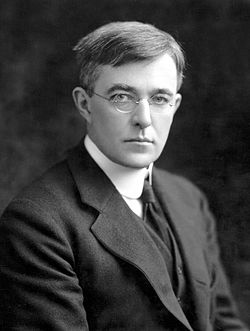
Irving Langmuir
🏆 Nobel Prize in ChemistryNobel Prize in Chemistry | (1915) | 1881-1957
View on WikipediaBiography
Irving Langmuir(/ˈlæŋmjʊər/;January 31, 1881 – August 16, 1957) was an Americanchemist,physicist, andmetallurgical engineer. He was awarded theNobel Prize in Chemistryin 1932 for his work insurface chemistry. Langmuir's most famous publication is the 1919 article "The Arrangement of Electrons in Atoms and Molecules" in which, building onGilbert N. Lewis'scubical atomtheory andWalther Kossel's chemical bonding theory, he outlined his "concentric theory of atomic structure".Langmuir became embroiled in a priority dispute with Lewis over this work; Langmuir's presentation skills were largely responsible for the popularization of the theory, although the credit for the theory itself belongs mostly to Lewis.While atGeneral Electricfrom 1909 to 1950, Langmuir advanced several fields ofphysicsandchemistry, inventing the gas-filledincandescent lampand thehydrogen welding technique. TheLangmuir Laboratory for Atmospheric ResearchnearSocorro, New Mexico, was named in his honor, as was theAmerican Chemical Societyjournal forsurface sciencecalledLangmuir. Fields: Chemistry, Physics Education: Columbia University University of Göttingen
中文信息
简介: 诺贝尔化学奖| (1915) | 1881-1957
欧文·朗缪尔(Irving Langmuir,/ˈlæŋmjʊər/;1881年1月31日-1957年8月16日)是一位美国化学家、物理学家和冶金工程师。 1932年,他因其在表面化学方面的工作而荣获诺贝尔化学奖。朗缪尔最著名的出版物是 1919 年发表的文章《原子和分子中电子的排列》,其中以吉尔伯特·N·刘易斯的立方原子理论和瓦尔特·科塞尔的化学键合理论为基础,概述了他的“原子结构同心理论”。朗缪尔与刘易斯就这项工作陷入了优先权争议;朗缪尔的演讲技巧在很大程度上促进了该理论的普及,尽管该理论本身的功劳主要属于刘易斯。1909年至1950年在通用电气期间,朗缪尔在物理和化学的多个领域取得了进展,发明了充气白炽灯和氢焊技术。新墨西哥州索科罗附近的朗缪尔大气研究实验室以他的名字命名,美国化学会表面科学期刊也以他的名字命名。领域: 化学、物理 教育背景: 哥伦比亚大学 哥廷根大学
Quick Facts
- Award: Nobel Prize in Chemistry
- Added: 2026-02-03
- Source: Wikipedia