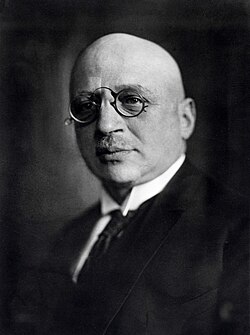
Fritz Haber
🏆 Nobel Prize in ChemistryNobel Prize in Chemistry | (1915) | 1868-1934
View on WikipediaBiography
Fritz Jakob Haber(German:[ˈfʁɪt͡sˈhaːbɐ]ⓘ; 9 December 1868 – 29 January 1934) was a Germanchemistwho received theNobel Prize in Chemistryin 1918 for his invention of theHaber process, a method used in industry to synthesizeammoniafromnitrogengas andhydrogengas. This invention is important for the large-scale synthesis offertilizersandexplosives.It is estimated that a third of annual global food production uses ammonia from the Haber–Bosch process, and that this food supports nearly half the world's population.For this work, Haber has been called one of the most important scientists and industrial chemists in human history.Haber also, along withMax Born, proposed theBorn–Haber cycleas a method for evaluating thelattice energyof anionic solid. Haber, a known German nationalist, is also considered the "father ofchemical warfare" for his years of pioneering work developing andweaponizing chlorineand other poisonous gases duringWorld War I. He first proposed the use of the heavier-than-airchlorinegas as a weapon to break thetrench deadlockduring theSecond Battle of Ypres. His work was later used, without his direct involvement,to develop theZyklon Bpesticide used for the killing of more than 1 million Jews ingas chambersin the greater context ofthe Holocaust. Following theNazis' rise to powerin 1933, Haber resigned from his position. Already in poor health, he spent time in various countries beforeChaim Weizmanninvited him to become the director of the Sieff Research Institute (now theWeizmann Institute) inRehovot,Mandatory Palestine. He accepted the offer but died ofheart failuremid-journey in aBasel, Switzerland hotel on 29 January 1934, aged 65. Fields: Physical chemistry Education: University of Heidelberg University of Berlin PhD Technische Universität Berlin
中文信息
简介: 诺贝尔化学奖| (1915) | 1868年-1934年
弗里茨·雅各布·哈伯(Fritz Jakob Haber,德语:[ˈfʁɪt͡sˈhaːbɐ]ⓘ;1868年12月9日-1934年1月29日)是一位德国化学家,因发明哈伯法(一种工业上用氮气和氢气合成氨的方法)而获得1918年诺贝尔化学奖。这项发明对于化肥和炸药的大规模合成非常重要。据估计,全球每年三分之一的粮食生产使用哈伯-博世过程中的氨,而这种食物养活了世界近一半的人口。由于这项工作,哈伯被称为人类历史上最重要的科学家和工业化学家之一。哈伯还与马克斯·玻恩一起提出了玻恩-哈伯循环作为评估阴离子固体晶格能的方法。哈伯是一位著名的德国民族主义者,因其在第一次世界大战期间多年开发和武器化氯气和其他有毒气体的开创性工作而被认为是“化学战之父”。他在第二次伊普尔战役期间首次提出使用比空气重的氯气作为武器来打破战壕僵局。后来,在他没有直接参与的情况下,他的工作被用来开发 Zyklon B 农药,该农药在大屠杀的大背景下被用于在毒气室中杀害超过 100 万犹太人。 1933 年纳粹上台后,哈伯辞去了职务。在哈伊姆·魏茨曼邀请他担任托管巴勒斯坦雷霍沃特的西耶夫研究所(现为魏茨曼研究所)所长之前,他的健康状况已经很差了,他曾在各个国家呆过一段时间。他接受了邀请,但于 1934 年 1 月 29 日在瑞士巴塞尔的一家酒店中因心力衰竭去世,享年 65 岁。 专业领域:物理化学 教育背景:海德堡大学、柏林大学 博士 柏林工业大学
Quick Facts
- Award: Nobel Prize in Chemistry
- Added: 2026-02-03
- Source: Wikipedia