Biography
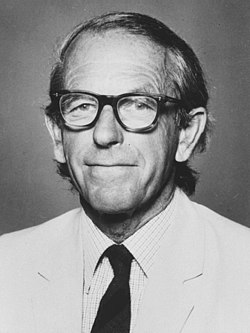
Frederick Sanger OM CH CBE FRS FAA ( / ˈ s æ ŋ ər / ; 13 August 1918 – 19 November 2013) was a British biochemist who received the Nobel Prize in Chemistry twice. He won the 1958 Chemistry Prize for determining the amino acid sequence of insulin and numerous other proteins, demonstrating in the process that each had a unique, definite structure; this was a foundational discovery for the central dogma of molecular biology . At the newly constructed Laboratory of Molecular Biology in Cambridge, he developed and subsequently refined the first-ever DNA sequencing technique , which vastly expanded the number of feasible experiments in molecular biology and remains in widespread use today. The breakthrough earned him the 1980 Nobel Prize in Chemistry, which he shared with Walter Gilbert and Paul Berg . Fields: Biochemistry Education: St John's College, Cambridge BA PhD
About the Lasker Award
The Lasker Awards have been awarded annually since 1946 to living persons who have made major contributions to medical science or who have performed public service on behalf of medicine. They are administered by the Lasker Foundation, founded by advertising pioneer Albert Lasker and his wife Mary Woodard Lasker (a medical research activist). The awards are sometimes referred to as "America's Nobels."
Quick Facts
- Award: Lasker Award - Basic Medical Research
- Added: 2026-02-07
- Source: Wikipedia
- Established: 1946
- Presented by: Lasker Foundation